



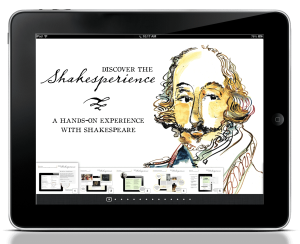
When the world of tablet reading exploded, so did the numbers of people looking for ways to enhance books, thereby almost changing what it meant to read. Voice-over narration, embedded soundtracks that shift with the action in the story, even hyperlinks or pop-up pictures and videos were added to titles. Children’s titles seemed to benefit the most from the engaging features, and many digital publishers pointed to the educational benefits of add-ons like highlighted text that displayed the words as they were being read. But did this really enhance the experience for older readers?
Dominique Raccah, CEO and publisher of SourceBooks, posted on the company’s blog about the enhancements that the publisher added to its newly digitized line of Shakespeare plays, The SourceBooks Shakespeare. With the text on-screen to be read, there are embedded audio clips from famous orators, video clips of award-winning renditions of the play, even a glossary to help students muddle their ways through the thousands of words that Shakespeare is known to have contributed to English.
“Fundamentally we’re working on the problem of immersion. How do we get you to connect with the text more, and more easily? That’s a question that’s really at the heart of learning. And that focus on attention, flow, and engagement drove the interface and most of the decisions we made about what content to use and how to organize that content.
“This is obviously only the beginning for us, but it’s a thrilling start. Just watching people use The Shakesperience has been a real joy. We hope it can transform and energize how students learn, and think it can change the way you read Shakespeare,” said Raccah on the SourceBooks blog.
When asked about the difference between adding on to an ebook to make it more enticing versus embedding features to make the experience more seamless for the reader, Raccah told GoodeReader, “We spent a tremendous amount of time developing the user experience. It was the focus for us.”
The line of products, whether read by a fan of the Bard who wants a more in-depth experience or used by a student who wants to understand the text more fully, offers up a very focused series of enhancements. It’s not about enhancements for the sake of utilizing the available technology, but rather making the experience a very genuine one for the reader.

Mercy Pilkington is a Senior Editor for Good e-Reader. She is also the CEO and founder of a hybrid publishing and consulting company.