


Pixel Qi | Good E-Reader - ebook Reader and Digital Publishing News

Archive for Pixel Qi

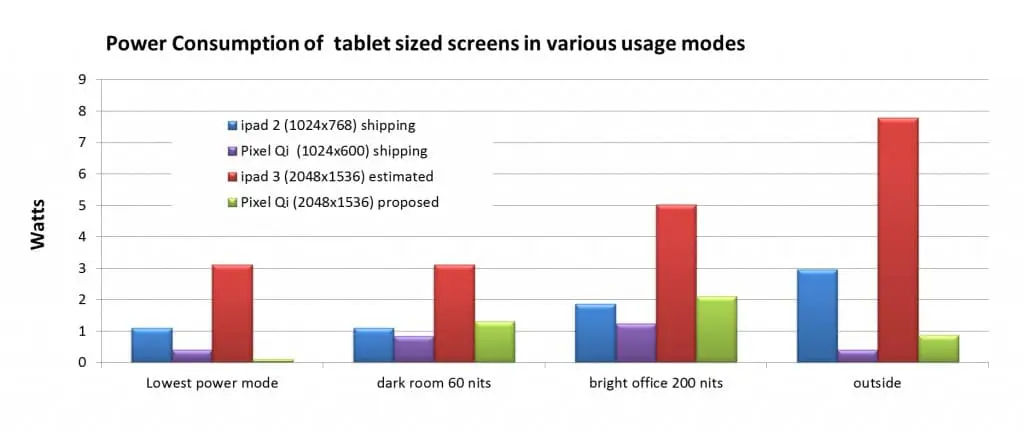
Pixel Qi is enamoured with the Apple iPad 3, but is not impressed with the overheating issue or the 8 watt power draw. The company is working on a next generation screen that draws very low power and has the same resolution. CEO Mary Lou Jepsen wrote, “We can now announce that we can match or exceed the image quality of the screen in the iPad3. We have a new architecture that matches the resolution of the ipad3 screen, and its full image quality including matching or exceeding contrast, color saturation, the viewing angle and so forth with massive power savings. We even added a very low power mode that runs at a full 100X power reduction from the peak power consumed by the iPad3 screen. We are finalizing our partner(s) on the development of this new screen family and the sizes we will make it in.”

One of the  main benefits of Pixel Qi technology is that it is designed to work in direct sunlight and poses an alternative to e-ink. It’s biggest mass market product was the Notion Ink Adam which was released a few years ago. When we caught up with John Ryan the CFO at CES, he said the company was focusing on Asia and the Military because the consumer market was not accepting the technology like he had expected.

Categories : Tablet News, Technology
Comments (0)

Pixel Qi is well known for developing a new breed of screens that deliver an unparalleled experience in direct sunlight and draw very low power. The company has seen their technology showcased in the early One Laptop per Child program in Africa, which initially drew industry wide attention to the company. In the last year their screens were featured in various ZTE Tablets in China and recently in the Notion Ink Adam. In the last six months 3M invested heavily in the future of Pixel Qi and has influenced the direction of the company away from consumer electronics to more specialized industries, such as the military

We have spoken with both the CFO and CEO over the years at various industry events and their decision to gravitate away from the fickle nature of e-readers and tablets was a wise decision. The company instead plans to focus their attention on specialized market segments that would benefit more from their technology and lead to more long-term contracts.

One of the first ways they will deploy their Pixel Qi technology is within the military and give soldiers a new way to receive mission data. If you look at your average paratrooper or ranger they are constantly receiving revised mission parameters and in harsh conditions like a dessert. Being in very bright environments or dark make no different with Pixel Qi, whose very essence is low-power no-glare technology which would make lives easier. Most military operations worldwide still employ maps and written communications, to receive updates to their mission requires many steps and circumstances change many times. The plan is for soldiers to have heavily versatile tablets that last for weeks and are wired into mission control to receive new updates on the fly. Another way their technology will be employed is with the hydro electric community where operators are frequently in high elevations in direct sunlight.

3M’s investment in Pixel Qi is allowing the company to deal with multiple fabs in Taiwan where the company is based and diversify their portfolio. Obviously when you receive a huge investment from a mega-corporation whose reach is all-encompassing you will receive a ton of connections within very specialized niches. 3M is found everywhere from cars, phones, hospitals, and tape. This will turn the company around and we were told in the near future their technology will be everywhere, but in products we will never see. Obviously Pixel Qi is not stepping totally away from the end user experience and they are currently dealing with a number of existing clients in future product launches. Check out our whole interview where CFO John Ryan talks to us in detail about the new direction of the company and demonstrating two new screens they brought with them to CES 2012.


Sol is adding some more variety to its line of tablets this year. These would however be of 7 inch sizes with one running on Android and the other on Windows. For those who have come in late, the company already has a 10 inch netbook and tablet in the market, both of which are windows based. These devices have the added specialty that they have Pixel Qi displays which make them visible even in sunlight.

However, there is not much that is known of the upcoming 7 inchers except that they would pack in 1024 x 600 pixels. A prototype running Android is there at the CES though its specs are still to be finalized.

As for the 10 inch tablets SOL has on offer, the Pixel Qi display might just be the only high point about it and if you still feel that alone is enough to go for it, well there is the almost absurd $1099 price tag to negotiate. That notwithstanding, he founder of Sol, Chris Swanner, mentions that at the selling price the company is not making much of a profit. At present the company is able to sell just about 20 to 30 units every month though in case demand goes up, there is definitely the possibility of price coming down. But till then, it would continue to be a niche product suited more for outdoor application. Like the SOL computers with Pixel Qi displays can come in handy with pilots or engineers deployed at construction sites where there often is bright light and glare isn’t an issue. The tablet otherwise has an 1.6 GHz Intel Atom N455 processor at its core that works in conjugation with a 1 GB RAM.

As for the dual display Pixel Qi screens, its basic function is that it has two display modes. With the backlight on , the screen is transformed into a color display. When the backlight is turned off, the screen turns into a high contrast black and white display. Its specialty is that the display is clearly readable even with just ambient lights on and consume much less power than their standard LCD counterparts. However, in spite of its goodness, we haven’t seen much of the Pixel Qi displays in real life and the only high profile tablet featuring it — NI Adam hasn’t been much of a success either.

via techcrunch

Categories : CES, Tablet News
Comments (0)

pixel qi

Pixel Qi and China based Shizhu Technologies have ironed out an agreement to release 4 new tablet computers. Pixel Qi will be providing the screen technology that draws less power and makes it easy to read in the sun. These tablets will be multimedia based and will also be used for reading.

Shizhu Technology will be targeting the growing e-reader demographic in China. The company also has a partnership with the Southern Media Group that reaches millions of subscribers each day with their digital content. Presumably the Pixel Qi screens will be used on the devices to read digital content.

Pixel Qi was in the news last month when it received a hefty investment from 3M. Many people are disappointed with the battery life of tablets and phones. The average device has a maximum ability for about 10 hours of use before you have to re-charge it. Pixel QI screens would be perfect to extend these charging cycles to double the time because of the low wattage the screens draw from the battery. Stefan Gabriel, President of 3M New Ventures said: “Pixel Qi’s technology enables displays of such lower power and high usability that the vision of ubiquitous displays comes much closer to realization. In combining Pixel Qi’s disruptive display technology with our technology platforms, we can create new business opportunities in the consumer and commercial markets for 3M.”

Categories : Tablet News, Technology
Comments (0)

pixel qi

3M Ventures an investment arm based in Germany has just invested in Pixel QI for next generation mobile display screens.

Pixel QI has finally found the suitor that it has been looking for the last few years to bring its products into the mainstream. The core basis of its technology is to provide low cost LCD screens that are readable in direct sunlight. They also mimic the traditional e-ink experience and side by side with Kindle display text in ultra high resolution.

The company was formed in 2008 and its claim to fame was with the ‘One Laptop Per Child’ initiative that targeted Africa where there was plenty of sunlight and a demand for devices that were either solar powered or low in cost. Their technology is showcased in devices such as the Notion Ink Adam and in the ZTE Android tablet.

Pixel QI has been one of the companies we have been very high on since we conducted interviews with John Ryan and CEO Dr. Mary Lou Jepsen at CES and Computex in Taiwan. Their display screens were seen in laptops, tablets and even phones. The one thing I really liked about their technology was that despite the fact it is low cost they provide high quality screens that are perfect for the mass market.

Many people are disappointed with tablets and phones battery life. The average device has a maximum ability for about 10 hours of use before you have to re-charge it. Pixel QI screens would be perfect to extend these charging cycles to double the time because of the low wattage the screens draw from the battery. Stefan Gabriel, President of 3M New Ventures said: “Pixel Qi’s technology enables displays of such lower power and high usability that the vision of ubiquitous displays comes much closer to realization. In combining Pixel Qi’s disruptive display technology with our technology platforms, we can create new business opportunities in the consumer and commercial markets for 3M.”

Pixel QI intends on using the undisclosed sum of money to increase its sales and R&D to innovate new products. If you are unfamiliar with the company and its display screen technology check out some of the past interviews we conducted with them and gain an introspective on how the screens work and look aesthetically.


Categories : Tablet News, Technology
Comments (0)

OLPC or One Laptop Per Child’s dream of coming up with a super cheap (read $100) laptop may not have had the type of success that Nicholas Negroponte had dreamt of when he got started with the project but he definitely isn’t giving up yet. However, the entire personal computing segment underwent a paradigm shift in the last one year or so with the advent of tablet PCs. Negroponte too had announced the XO-3 tablet concept though he is also back to his usual lofty goals which no doubt are excellent on paper.

Like the latest that has emerged of the XO-3 tablet point out the tablet to have a rubberized coating together with the option of solar charging along with satellite Internet connectivity. While the primary role of the rubber coating will be to impart protection to the tablet, solar charging options along with a satellite internet modem will no doubt be a boon in developing countries where both power and reliable internet connection is often not accorded the top most priority.

Among the other details that has emerged of the XO-3 tablet is that it will have provisions to get attached to an external keyboard and will also include features that are pretty much common on almost all regular tablet PCs. These include an USB 2.0 port, a camera built along the top of the screen and integrated into the bezel, a microphone inside of the lower bezel, and a headphone jack along the side.

As for the display, a spin-off of Pixel Qi’s hybrid screen might find application here though there is still some debate going on internally on this. OLPC’s choice is to go for a display with a dual functionality of an energy saving e-ink mode as well as a normal LCD mode that can display full-motion video. An obvious power saving method can be to make the display to absorb ambient light to brighten the screen.

Negroponte also revealed the XO-3 tablet will have an ARM based processor and will run either the Google Android or a different Linux based operating system. Windows 8 has been ruled out as Microsoft had refused support for ARM chips with the software during the time the XO-3 was under development.

The XO-3 tablet has been in the making since 2009 but should be ready for a market debut by 2012. Lastly, coming to the price, Negroponte is sicking to the sub $100 price tag though it remains to be seen if some of the exotic features will form part of the base model or may be offered as an optional extra in some of the higher speced version.

via pcworld

Categories : Tablet News
Comments (1)

notion ink adam 2

Today we broke the news that the Notion Ink Adam 2 is in development and should be ready by December of this year. CEO of Notion Ink Rohan Shravan said that the company will debut the unit at CES 2012 in Las Vegas, which we will be attending. Earlier in the month we were in Taipei Taiwan for Computex 2011 and landed an exclusive interview with Pixel QI CEO Mary Lou Jepsen. She told us that they had developed a next gen screen for the Notion Ink Adam and had a display model showing it off. It seems as though this new screen will be the one the Notion Ink Adam 2 uses and not for the Adam 1.

The big problem with the existing screen in the Notion Ink Adam employs with the Pixel QI technology is two fold. Not only do the colors look washed out, but it does a poor job in the direct sunlight. This defeats the entire premise of using Pixel QI screen technology, whose essence is performing well in the light.  The new screen that the Adam 2 is going to use employs better film that cuts down on screen glare and does a better job on the Adam. This was the huge concern with the Adam in general that it almost had dual screens which made for a lackluster experience.

We have also heard some rumors out of the Notion Ink camp today! A source within the company told us that the Adam will be using the new Nvidia Tegra 3 processor! When we were at Computex we met with 2 senior Nvidia representatives who gave us a technical demonstration of the prototype Nvidia Tegra 3 quad core processor. This unit was amazing featuring 12 GPU cores! The resolution for this new processor does take it to the next level with 1440p! This is two times 720p and is 1.5X better then the latest 1080p. Not only will this new Nvidia Tegra 3 processor be able to handle superior resolution, but the lead engineer told us that it easily handles 3D. In general, 3D requires double the frame rate (120 frames per second) and double the pixels.

The same source told us a few other tantalizing tidbits! We heard that the Adam will ship with Google Android Honeycomb 3.2 as the operating system of choice, allowing the Adam to enter 2012 with a relevant operating system. Finally we heard the company was considering 2 rear facing cameras to shoot video in 3D ala the LG G-Slate.It will also have the same front facing camera that we see in the current iteration of the Adam.

One of the biggest problems with the Adam so far was the shipping and delivery system with the initial launch of the device earlier this year. Many customers cannot simply buy the device but have to jump through various hoops of pre-order rounds.The Adam 1 came onto the scene with lots of viral hype but it had sparse availability which hurt their sales and negative reviews  made people switch to other devices. It also shipped with an older version of Google Android 2.2 and the road to even 2.3 has been a long one.

I am firmly excited at the Adam 2 having all of these features in the next build, the Adam 1 was great and we reviewed it extensively. The big changes with the new display technology should go a long way with making a large screen tablet have bright and vibrant screen resolution and will be 50% better then the current iteration of the Adam in Pixel QI mode. I am also pleased that the company decided to go with a better processor in order to be relevant during the long term. If the rumors on the 3D camera are to be true, this will mean that the Adam will be the highest performing 3D Tablet on the market. I do hope that with the added investor capital they got recently, paired with the manufacturing connections,  will allow the Adam 2 to enjoy higher volumes and shipped quickly.

Here is a video of the new screen to be used in the Notion Ink Adam 2


Comments (12)

We caught up with Mary Lou Jepsen, the CEO of Pixel Qi and John Ryan who walked us through some of the new products and screen technology the company has been working on.

The company has been working fervently on the next generation of Pixel Qi technology to provide a low power, high resolution display panels. They also showed us some new devices hitting the market soon that utilizes their screens. One of the main new functions was using Infrared technology called IR Touch, this is the same technology found in the new Kobo Touch.

Lets talk about the new display panel offerings the company has been developing first. The first screen was a seven inch panel that has a resolution of 1024×600 and draws tremendous low power from the battery. While the second screen was 10 inches and had 1280 by 800 pixel resolution. This new 10 inch screen was specific designed to be an Android 3.0 tablets, which is why they went with IR-Touch technology. Both of two new screens will basically save you 80% battery life. These two screens will see full production in the fall of this year, hopefully we’ll see some new tablets using it.

One of the huge benefits of using Pixel Qi technology in screens for Tablets us because of the size real estate. The color is vibrant but they are VERY small compared to LCD based screens. This means the companies technology is 3/4 the size smaller then normal screens and can provide ultra thin tablets in the future. The company showed us their new solar powered tech that would further reduce the size of tablets that utililze both Pixel QI and the Solar powered battery. Most tablets are bigger and bulkier due to factors like screen density and battery. Being able to shave both screen size and battery size will go a long way to creating ultra thin devices.

The company using solar power technology takes its roots from Pixel Qi’s first project, One Laptop per Child. Originally the technology had to be readable in sunlight and have long battery life. Combining these two factors has created low cost ($130) computers for some of the poorest countries on earth. Being able to implement the solar powered technology within the One Laptop Per Child framework would further reduce the costs for the end user. So the display panels the company makes are not just limited to tablets but can be used in low production cost netbooks and laptops.

Pixel Qi has signed on some major new partners which they announced at Computex 2011. We saw the finished product for the largest telecommunications provider in China ZTE. The new device was a 7 inch Google Android product called the ZTE light, it should see the light of day around Fall 2011. Also on the new hardware front we saw another great Google Android tablet that was designed very well.

Finally, don’t forget about one of the major partners of the company that issued a new tablet this year, the Notion Ink Adam. Many customers have been dismayed that the Adam was very reflective and glossy when out in the sun or under direct light. Part of this was due to the dual panel the tablet used and contributed to a lackluster experience. Pixel Qi has developed a new screen type customized for the Adam and should be used in future device manufacturing. While checking out an Adam with the new screen that was on-site we saw a tremendous improvement. Check out our video on the Adam display panel HERE.

Pixel Qi is one of the most innovative companies in the current market climate. The company constantly demonstrates new technology and display panels that would be suited for both e-readers and tablets. I long for the day I could use a tablet thinly veiled as an e-reader and actually have Pixel Qi under the hood in order to enjoy full color when I want, then e-ink quality reading experience.

Cincopa WordPress plugin

Pixel Qi demonstrated to us at Computex a new screen they are going to be using for the Notion Ink Adam that will reduce glare and give a better experience utilizing the Pixel Qi mode in units that support it.

Anyone who has purchased the Notion Ink Adam or saw any of our videos comparing it to an Amazon Kindle or our direct sunlight tests all noticed one thing, there was tons of glare on it. Notion Ink recognized the glare factor and packaged plastic screen protectors on the unit. Although they were nothing but screen protectors they did help disperse the light a little bit. This is why Pixel Qi making new screens for the Adam is such good news.

John Ryan the COO of Pixel Qi told us that the new screens were in development and they were relying on Notion Ink to adopt the new technology into future manufacturing. The screens themselves looked tremendous compared to the previous iterations and even with trade-show lighting there was no glare at all. The display models they showed us at Computex was a new film layer they had on-top of the screen.

We have to hope that the Notion Ink is going to adopt this new technology into future Adams because their current crop of Pixel Qi screens has been received with a lukewarm response.


Categories : Tablet News, Technology
Comments (11)

The China based ZTE has introduced a new tablet at the ongoing MCW that includes the sun light readable Pixel Qi screen. The other nice thing with the new Android tablet named ZTE Light 2 is that it comes with a 7 inch display making it the first in the segment to include the liquid crystal Pixel Qi display. Almost every other Pixel Qi based tablet that has seen the sun light has been in the bigger 10 inch segment.

“We are excited to partner with Pixel Qi to bring their innovative display technology to market,” stated Adam Zhang, VP and President at ZTE Mobile Broadband Device before further adding: “It brings a new level of performance to our family of tablet PC’s, rendering excellent images under any light conditions.”

The mood at the Pixel Qi camp is equally upbeat with their latest venture, something that can be summed up in what the CEO and founder of Pixel Qi, Mary Lou Jepsen had to say of the development: “Working with ZTE, a world-leading telecommunication company with a global customer base, provides us with an extraordinary opportunity to address a world-wide market.”

The Pixel Qi bit apart, the rest of the Light 2 story comprises of a 1 GHz processor along with 4 GB of internal memory while its Android 2.2 Froyo as the default operating system. The 7 inch multi-touch capacitive touch screen display boasts of a 1024 x 600 pixel resolution, packing in a healthy pixel density of 170 pixels per inch. Also, like it is with a Pixel Qi display, the new ZTE tablet also impresses with its outdoor readability, delivering a high contrast  monochrome display out in the sun when the backlight is off along with a full color display when indoors with the backlight turned on. Not to mention the Pixel Qi display’s already award winning low battery consumption qualities. However, there isn’t all the details available just yet though we hope the Light 2 becomes a market reality soon enough.

So all in all, the new Light 2 presents a nice option to those who would like to have a taste of the innovative Pixel Qi display in a smaller package. Something that will be more pocket friendly, both size and price wise.

via pixel qi blog

Categories : Tablet News
Comments (8)

pixel qi vs e-ink

Squirreled away in hidden meeting rooms contained the executive layer of Pixel QI! It contained a very small meeting space that normally contained sales meetings between Pixel QI and companies looking to employ this new screen technology in tablets, laptops and computers. Someones cancellation was our good luck, as we got a first hand look at some of the new technology being employed in 5 inch, and 7 inch tablet devices. We even got a sweet comparison between the Amazon Kindle’s e-Ink and Pixel QI, to give a sense on how the resolution differs between the two units.

John Ryan, Chief Operating Officer of Pixel QI was gracious enough to give us a comprehensive overview of their humble origins in providing hardware for the “one laptop per child program.” The main premise was to provide a low cost unit that had high battery life, and functioned well in direct sunlight. He then showed us a few laptops that ran a Freescale CPU with a 3 cell battery that boasted a 10 hour battery. We saw some prototypes for a new 10.1 inch Tablet called “Accusee” that featured a Intel Atom N450 processor and a resolution of 1024X600. It had a sweet capacitive screen that came with a stylus and an ambient sensor that automatically switched to Pixel QI mode from normal LCD mode depending on your environmental light. The comparison John drew was using a cell phone at night in your room, and how it would illuminate the entire room when you used it. This new tablet took advantage of the darkness in the room and made sure the content on the screen would not be blinding.

Pixel QI and e-Ink technology are seen to be in strong competition with each other, while e-ink has been around for a bit longer then the new technology has, when we saw the side by side comparison with a new prototype new e-reader screen we really saw the difference and can see a strong future with e-readers utilizing QI screens. For example, one of the big reasons why we do not see video on e-readers is because of the redraw rate. This is quite evident in lower quality electronic readers that have a high degree of waiting time when you turn pages, activate menu functions or surf the internet. Each page you turn or new feature you load prompts the e-ink based device to redraw every line on the surface area. Pixel QI, because it is TFT-LCD based, but provides 16 shades of gray scale when switched into low back-lite mode. This is a tremendous advantage to Pixel QI that it basically emulates e-ink in terms of a weak LCD glare you receive and a super high degree of contrast on the text. Combined with the fact that you can play high resolution video while in the gray scale mode on the Pixel QI screen, we see a future where e-reader companies switch to this technology.

When we saw the side by side comparison of the Amazon Kindle and Pixel QI technology side by side, the differences where almost indistinguishable, and the text resolution actually had a higher degree of contrast on the Pixel QI prototype then the Kindle.

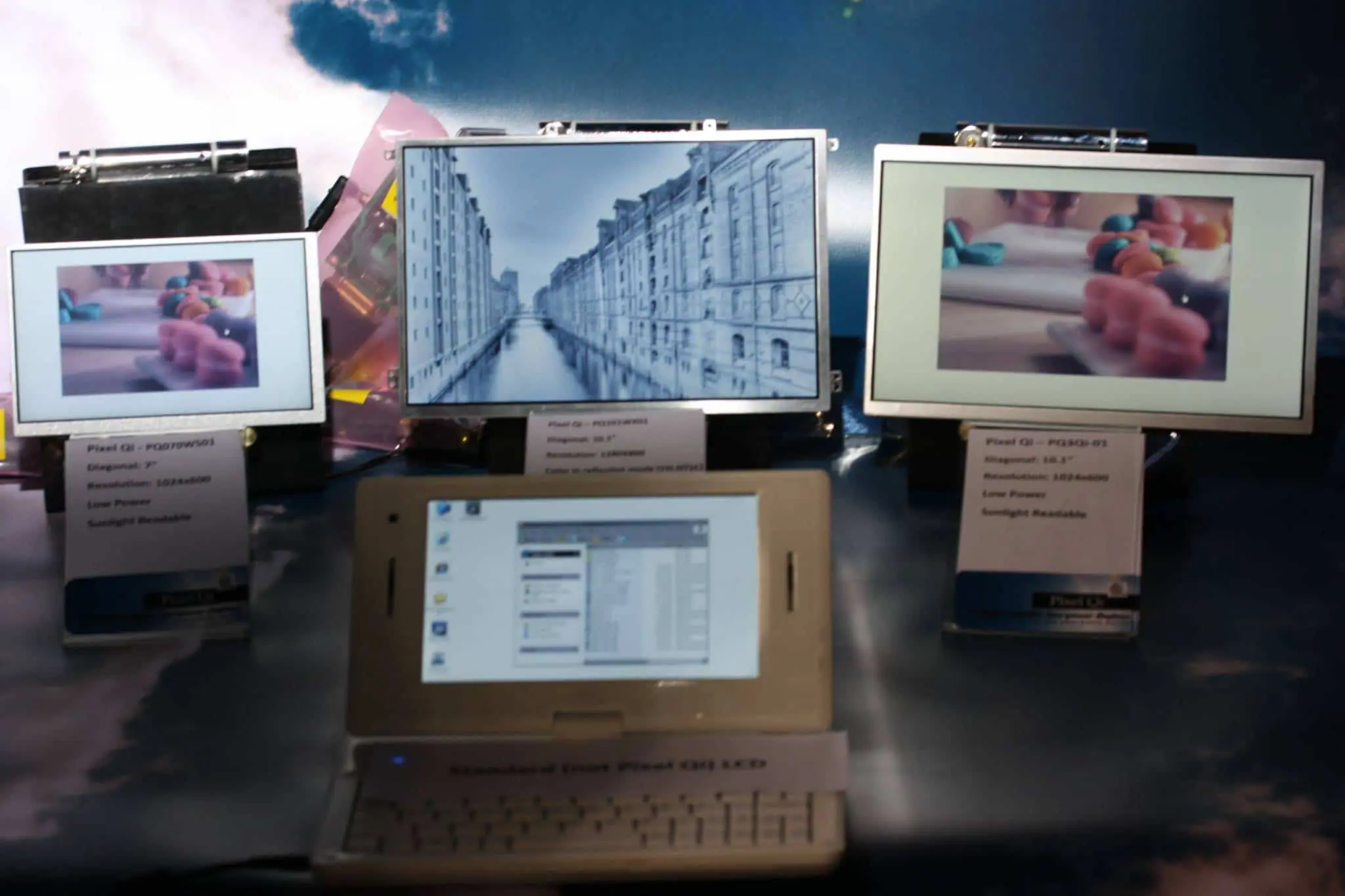
We ended the showcase looking at a few single pane screen prototypes, a 10.1 inch screen and a 5 inch screen that were less then 2mm thick, and provided such a high degree of color and contrast we envisioned this technology being used in smaller pocket sized tablets and smart phones. Make sure to check out our video of the comparisons and pictures of the technology below.

Cincopa WordPress plugin

Pixel Qi technology should get its chance to shine this year via the higher end Notion Ink Adam Tablet. The Pixel QI TFT-LCD screens are great because they are low powered, and have the options to go gray-scale for a true E-Reading experience, or to go full color and get the most out of your multi-media content.

Look out at CES 2011 when Pixel QI in partnership with Chunghwa Picture Tubes have developed 3 different screens to capture attention from companies looking to involve themselves in the tablet PC free for all. The two companies have developed a 7 inch 1024×600 resolution touch screen panels and will show off a few 10.1 inch products at the convention in Las Vegas.

Regarding its cooperation with Pixel Qi, CPT noted that it is optimistic about reflective panel technology, and hopes launch the panel as soon as possible because of demand for small- to medium-size mobile devices, but CPT added that the Pixel Qi panel currently is still in development.

What exactly is Pixel QI and how is it relevant to Tablets and portable devices? It is based on the LCD technology, Pixel Qi can alternatively switch between transmissive and transflective mode which means one has the option of going for either the regular LCD or e-ink display.

Manufacturing of devices using Pixel Qi display technology has already started during late 2009 and the market has only seen a few devices packaged with the technology so far, most recently the Notion Ink Adam.

The advantage of Pixel Qi display is its ability to turn netbooks, laptops, tablet PCs into capable e-book readers but whether it will be used by regular e-readers is yet to be seen.

The main problem behind using LCD screen while you are reading for a longer period of time is its backlight facility, which leads to eyestrain and uneasiness. Needless to say, the problem can be addressed well by the use of Pixel Qi technology.

Undoubtedly, Pixel Qi is going to play a significant role in the e-reader segment and more of integrated and multifunctional devices with e-reading abilities is likely to be unveiled at CES and Computex in 2011.

via Digitimes

Comments (4)

It’s just human tendency to want more. Like while we would like to have displays that are resplendent with rich vibrant colors, we also want it to have the minimum impact on the battery. We also wish the display to be just as glorious out in the sun as it is indoors. But then perhaps we might have asked for a bit more.

While Qualcomm did promise us such a thing with its Mirasol display, the promise is still far from being fulfilled. A few more months is the earliest we can expect such a display to become a reality, as opposed to the first half of 2011 and not 2010 as was earlier envisioned.

The Mirasol display, once they become a production reality, will be seen on e-readers and tablet PCs and it has the potential to usher in a revolution in the field of display technology. Once the Mirasol display becomes ready, it will be somewhat like the brilliant Pixel Qi that works just as superbly out in the sun as indoors, while drawing the minimum from the battery. And if anybody that will be happy by the latest delay to hit Qualcomm, it will be perhaps Pixel Qi as its got a few more months to have the entire market for dual display mode to itself.