


Archive for sony
New Updates to the Pottermore Site
Posted by: | CommentsPottermore, the popular online virtual world based on the bestselling Harry Potter books from JK Rowling, has been several years in the making. This strategy of unleashing and adding new content to the site is in line with the order of the books, and actually functions to engage existing fans chronologically while aging up with new ones.
This week, Pottermore announced new updates to the site and new material from the third book in the series. The company also informed subscribers that it would be sending email updates when new content was added. One of the important updates to the site will be the ability for fans to visit content in any order they choose, no longer requiring users to complete leveled tasks in order to open content. This gives more freedom over the interaction with the wizarding world.
Pottermore CEO Charlie Redmayne spoke to The Bookseller about the revamp of the site, and made a very forward-thinking confession about the interactivity: “As it stands, if you don’t know the books you won’t get much out of it. What we want to do is open it out for those people who haven’t read the books, or who haven’t seen the films, but perhaps come to it via the Lego, or the Harry Potter computer games.”
Beyond just the interactive fun and new features that the site brings to fans, Pottermore has practically become its own franchise within the Harry Potter franchise. Along with its CreateMore site that is reaching out to other established entities like The Guinness Book of World Records to create similar fan environments, Pottermore has a presence with Sony Wonderbook, Playstation Home, and Sony 3D platforms to bring the experience to different game users in different approaches. Of course, the Pottermore site remains the exclusive portal for sales of the ebook editions of all of the Harry Potter titles, a testimony to the foresight Rowling had for everything involving her boy wizard.
Sony Discusses Digital Books and the Growth of the Reader Store
Posted by: | CommentsSony has been selling e-readers since 2006 and has been operating its own ebook store for a number of years. The company has expanded its reach within the last year, opening new stores in UK, Japan, Germany, Austria, Canada, and Australia, and it will be coming to France, Italy, and Spain. Every few weeks, Sony has been announcing new content partnerships and new enhancements to the store. Today, we spoke directly with Sony to get a sense of the company’s overall mentality when it comes to selling ebooks.
Sony is putting a priority on ebook discovery with the launch of infographs and Discovery Trees. Natascha Helbig, director of Reader Store for US/Canada, explained “Our team puts a lot of thought and work into these discovery tools and the response has been very positive. In an online ebook store you get often overwhelmed with the sheer amount of titles available so often customers tend to go for the author or series they know and like. We wanted to create a different and unique way of guiding customers to new reads by way of relating them to other books they might have read. Recommendation engines can only do so much; they don’t quite replace a real person knowing the books and how they might be relevant to customers.”
How exactly does Sony aid ebook discovery? “We are doing a variety of things to help our customers discover their next book and are planning to launch even more features this summer. We think some relevant titles can always be discovered via algorithm-based recommendation mechanisms in the store, but we focus on having our team put together tools in various genres to discover new books and authors, be it through our discover infographics, our Sony Reader Store blog, our curated collections and our staff picks,” Helbig explained.
In October 2012, Sony launched its online book club. Every month a new ebook is selected and special social media channels are developed to give readers a place to talk about the book. Often, Sony gets the author to engage the community in a Q/A. Natasha talked a bit about this and said, “We always look for new and exciting ways for our customers to discover new books and authors, and to learn more about the authors they love. The Sony Readers Book Club was a great experience which brought us closer together with our customers and allowed us to all participate in a reading experience together. We had hundreds of applications for the club and our online chats generated millions of impressions. The book club was a great way to discover new authors and titles and facilitate lively discussions amongst our customers and authors, and those are themes you will continue to see at Reader Store.”
The big priority with ebook sales used to be the dedicated line of e-readers, since that has been the big focus for the last seven years. Most of the core customers Sony has are switching to mobile and tablet devices to consume their media. This allows for more multimedia features, such as audio, video, and interactive elements. Recently, a new EPUB3 section has been introduced on the Sony Reader Store, to give people a dedicated portal to enhanced ebooks. “Sony has been very supportive of the industry standard ePub format so it was a logical step for us to be one of the first retailers to support ePub3, including embedded audio/video and read-along functions. We’ve been working very closely with our publishing partners to create the first ePub3 titles, which was a collaborative effort. We initially focused on children’s titles and sales have been very encouraging. Sony also just launched its newest tablet, the Xperia Tablet Z. Its new features make it the ideal family tablet and enhanced children’s ebooks were a great fit. That said, we will support ePub3 files in other categories as well and encourage publishers to experiment with the new format and push the boundaries of what ebooks can become. We’re excited to be part of this evolution.”
Given that Sony’s shifting strategy is tablets, how are sales on that platform, when compared to e-readers? Natascha said, “Most of our customers used to buy content through our desktop app Reader for PC, but with the launch of our web store last year, the majority of customers transitioned to that storefront. The web store is such an easy way for customers to buy books wherever they are and then they can download the titles on any of the devices they use. We have also seen a spike in purchases on the tablet and mobile storefronts, particularly in the last year, both on Sony Tablets as well as third-party tablets and phones.”
Speaking of sales, Sony tends to never publicly release metrics on overall sales and market reach. Natasha gave a bit of a perspective on what ebook genres do the best. She said, “Fiction is definitely the strongest category for us. Our most popular genres are Romance, Mystery & Thrillers, Fiction & Literature, SciFi & Fantasy, and Young Adult.”
Integrating other services into the PRS-T1 and T2 has been a priority with Sony. The Overdrive App has been wildly successful with many people discovering they can borrow digital books from their local libraries. How much of an emphasis will Sony continue to put on these extra services? “We wanted to enable customers to do with our Readers what they already are accustomed to as passionate readers – and renting books from libraries was an obvious choice. The feature is extremely popular. In our latest Reader, the PRS-T2, we also worked together with Evernote to enable customers to read other content like personal notebooks or web clippings on their Reader, allowing customers to take their Readers with them, lean back and have plenty of reading choices right at their fingertips. Digital reading has to go beyond reading of print books and take advantage of what the technology enables customers to do.”
Finally, Sony confirmed that it has no current plans for magazines and newspapers on its platform. It is something the company is looking at, but it has nothing in place right now to launch anything formally. Sony also doesn’t have any plans to launch a dedicated self-publishing platform and instead deals with 3rd party companies to produce content for them. Also, with the rise of short-fiction, Sony doesn’t have any plans to currently strike a deal with anyone to add more of these titles into the library. “The ebook business is very important for Sony in North America. We offer a variety of terrific entertainment devices and services for our customers and our eBook team is playing its part in that Sony family.” Natascha wrapped up the interview by saying, “We are determined to increase our market share by continuing to offer a unique discovery and reading experience for both Sony as well as third-party devices.”
Sony Launches House of Fiction Family Trees on Reader Store
Posted by: | CommentsSony is aiding ebook discovery in its Reader Store with the new Fiction Family Trees program. It basically mashes two genres together and, via a heavy graphical aid, determines what you should read next. There is a ton of synergy between the way Sony presents this ebook discovery tool, blending it with the traditional infograph.
Sony said in a statement, “To use the Family Tree, just trace the lineage to find out which new voices we’ve noticed have similarities to some of the greatest reads of our time. Each of the families combines our favorite attributes of bestselling books—voice, characters, setting, style, etc.—and guides readers to a new book they may not have otherwise found.”
Every week Sony will launch a new Family Free, the next one will merge Romance and SCI-FI. I think this is a neat move by Sony to do something no other ebook store is really doing. The essence of the program is to take people out of their genre specific comfort zones and maybe introduce them to a brand new author.
A Second Look at the Sony 13.3 Inch e-Reader
Posted by: | Comments
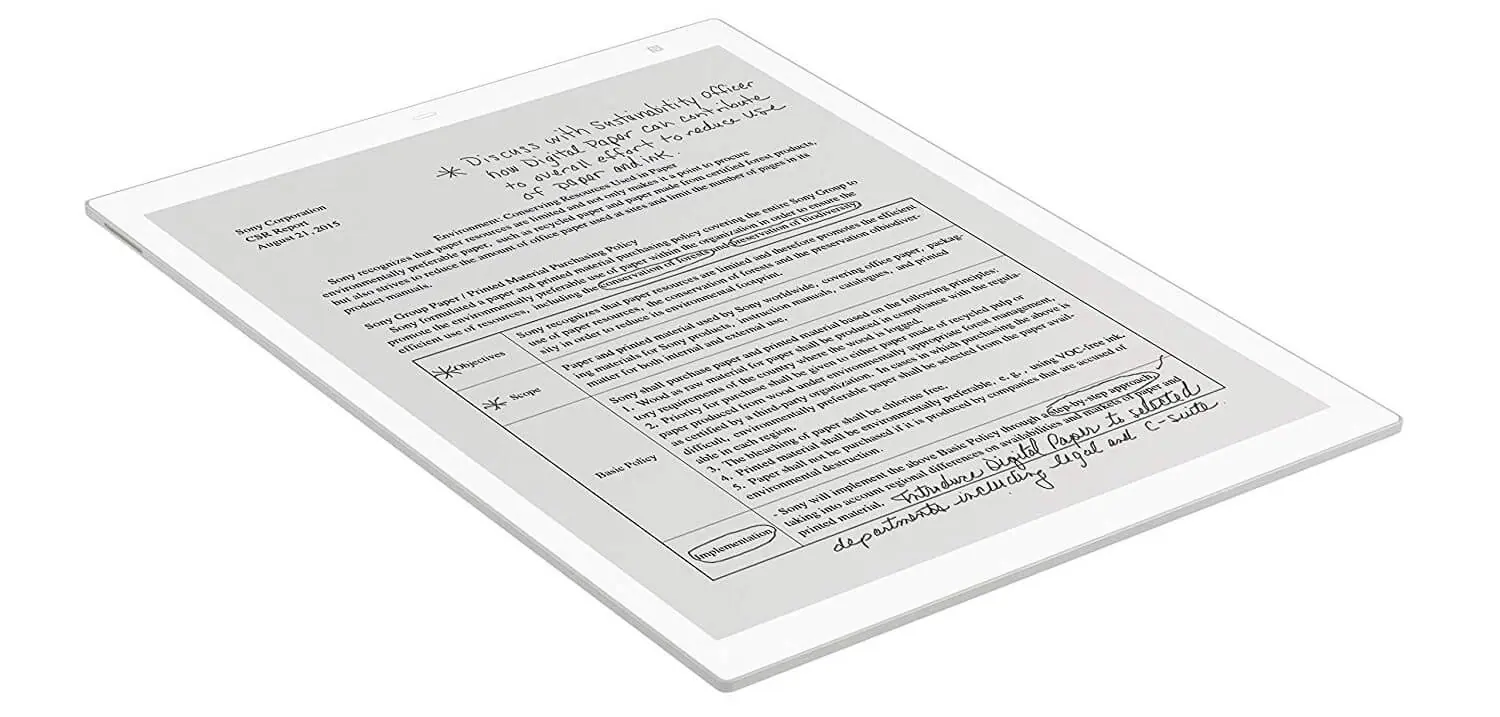
The Sony 13.3 inch e-reader is going to usher in a brand new era of high quality e-paper that allows for a true PDF experience. Sony has exclusivity over this brand new technology it created and worked on, in conjunction with E Ink. On the first day of SID Display Week, we were walked through some of the core features, but was that really enough? We received hundreds of emails, comments, and messages asking us to look deeper into what this has to offer. We have heard your pleas, and will show you mercy. I won’t rehash the specs of the hardware, you can read all about it HERE. There are some very exciting elements to this device that no one but us has managed to capture.
The PDF reading is the main attraction of the 13.3 inch e-reader and gives you a true, full page experience. Obviously you can take notes and make annotations by either writing with the stylus or the full virtual keyboard. If you make a note, you can save that page as an independent file. If you have a big PDF document and make all sorts of edits, you can save it as a “Workspace” into its own PDF document. This ensures you have your virgin file with no edits, and then your changed document with all of your notes.
If you have a large document with many notes, you can actually initiate a new feature that will allow you to look up all of the notes or changes you made on the document. A search feature will bring up a list on the right hand side, listing every single change you have ever made. If you tap on any of them, the page will open.
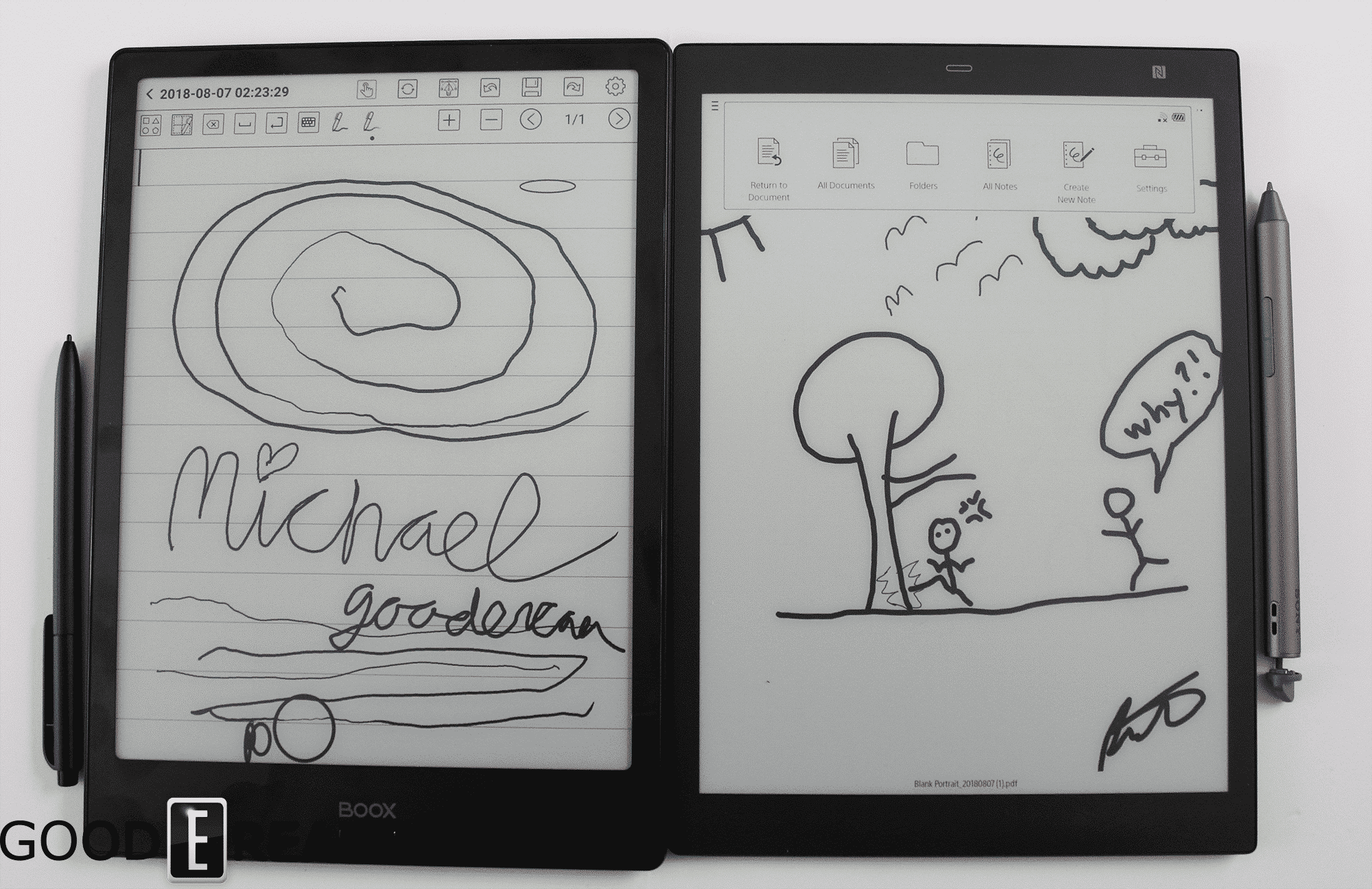
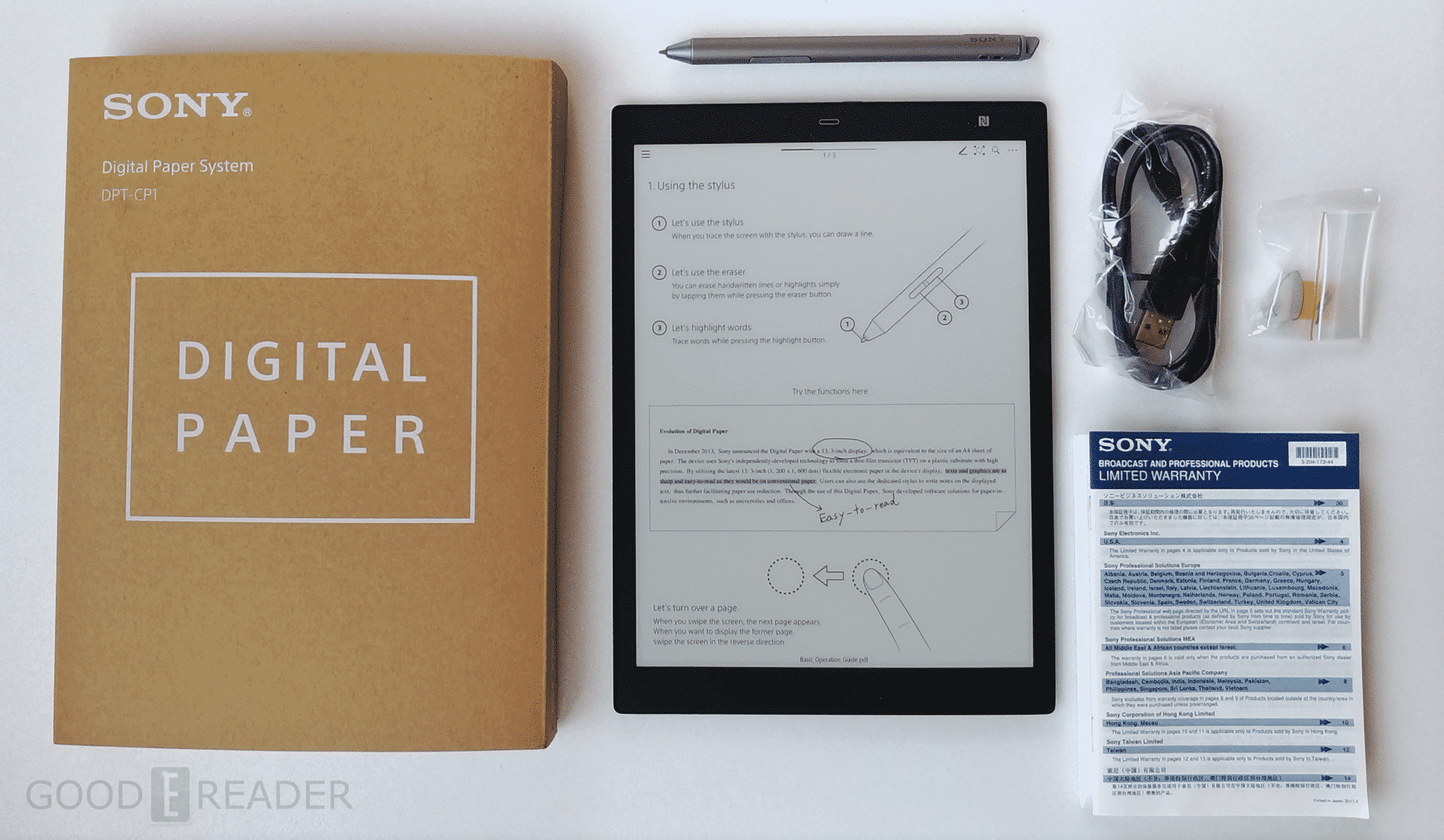
There was some confusion over the Stylus or Digitizer that came bundled with the Sony e-reader. Some people were saying the screen would not work without it and there was an air of uncertainty. I found out that you can do everything via touch. The stylus is useful for drawing notes or making changes. You can turn the pages and interact with every single menu with your hand. There is a small button on on the stylus that acts as an eraser. Click on a body of text or notes, and you can delete it.
There is a nice fully featured internet browser, that is accessible via a WIFI connection. Browsing the internet does not cause a massive amount of page-refresh issues, that normally plague lower-end devices. This might be perfect for people who check news websites, such as Good e-Reader!
E Ink was very clear that the firmware and overall design might change on the commercial release. I noticed it did not currently have EPUB support, which means you will not be able to load in your own books. Likely, we will see Sony’s own ebook store loaded on the device, and it will allow users to purchase ebooks directly from their region’s store. Currently, Sony has been opening a number of new online stores in Europe, UK, Australia, and many other markets. It would make sense for the company to incorporate this into its technologies.
Currently, the prototype is at many different events during the next few months. Sony is listening to people’s opinions and incorporating changes into the firmware and hardware. My suggestions were to hot-key the stylus eraser button to do different things. As an example, it would be nice to turn to the next page with a click. I also suggested the ability to pinch and zoom. It seems that you can’t make the fonts any larger or increase your zoom levels. This would be essential, as some people prefer bigger fonts or like to focus on specific bits of information.

Hands-On with the Sony 13.3 Inch Prototype e-Reader
Posted by: | Comments
Sony announced a new 13.3 inch e-reader last week that uses technology the company developed internally and in conjunction with E Ink Holdings. The new Sony e-Paper reader will seriously appeal to anyone that has lamented that their PDF reading and editing experiences have been sub-par on six inch devices. At SID Display Week in Vancouver, we caught up with Giovanni Mancini, the head of RND at E Ink, to check out the new Sony e-Reader.
This was the lightest device I have ever played with in the history of e-readers. The 13.3 inch screen is beguiling to behold and you would figure from looking at it that it would weigh significantly more than the Kindle DX. In truth it weighs only 12.6 oz, compared to the Kindle DX, which weighs a hefty 18.9 oz. The e-paper screen glides like a feather when dropped, as I found out.
The screen itself is quite respectable in terms of resolution and pixel density. The resolution on the display is 1200×1600 with 150 PPI. It is dubbed Mobius by E Ink and the company is actively shopping it around to the who’s who list of the e-reader world. The main attraction is using the active digitizer and interacting with complex PDF documents. You can edit documents by jotting down your own handwritten notes, or even highlight passages to go back to later. The large screen display will simply give you the best PDF experience you have ever had on an e-reader. I have personally reviewed over 83 different e-readers since launching Good e-Reader in 2009, and this was the first one to give me a quality PDF experience. I have received emails from airline pilots, heads of research divisions, and publishers about what device they should buy to read their PDF Files. I would implore everyone to buy this Sony one when it comes out; it changes the game. I don’t normally gush about things like this, but when it comes to school, work, newspapers, gaming guides, and technical PDF documents, this is solid.
The software right now is quite buggy, and we often found ourselves hitting a function key many times before the feature loaded up. The digitizer pen has a small button it that allows you to erase things when pressed. One of my concerns, along with some of the other media people there, was that the “erase” button was placed where you naturally grip the pen. This may result in you pressing down on it during your natural tendency to grip the stylus like a pencil. We noticed that when you are holding down the button, you can’t launch any commands or click on any of the GUI buttons. This forces you to write on the e-reader in a very unconventional way that may take some getting used to.
Sony Reader Store Now Available in Australia
Posted by: | Comments
Sony has just unveiled its new Australian Reader Store that seeks to capitalize on a growing ebook market. The company intends on swaying people over to its ecosystem by offering a different free ebook every day. Sony is also showcasing hundreds of books written by local writers.
Expanding into foreign markets as been a priority with Sony, with the UK and European relaunches and aggressive marketing. The move into Australia helps Sony eventually roll out new e-readers and garner domestic sales for hardware and digital content.
“We are proud to bring our Reader Store ebook offering to customers in Australia. With the widely accepted, open ePUB format and our focus on local Australian ebook selections, we believe Australians will be excited to choose Reader Store for any book they want to read.” says Tad Kitsukawa, Managing Director Sony Digital Reading Services.”
Kobo, Apple, Amazon, Google, JB-Hi-Fi, and many other online stores certainly give Australians a ton of viable options to buy ebooks. The overall book landscape has certainly changed in the last few years, with the bankruptcy of REDGroup, Angus and Robertson, and Borders. Currently the overall Australian ebook market is thought to be the seventh largest in the world.
The Slow Demise of the Japanese Electronics Industry. Here’s Why.
Posted by: | CommentsThere have been a silent but far reaching changes in the consumer electronic scene over the last few years. It’s the slow but steady decline of the once mighty Japanese electronics industry; what we see today can be considered just a shadow of what it once was. Unfortunately, the shadow is only growing longer, which implies the sun might well be setting in the Land of the Rising Sun.
The likes of Sony, Sharp, Panasonic, Hitachi, and other popular Japanese brands are fast losing their grip on the electronics scene. In fact, the situation is so drastic that Hitachi has resigned completely from the electronics scene and has instead taken refuge in heavy engineering, once its forte. The company has washed its hands of making entities (read electronics business) and is instead into selling heavy machines as well as taking on the engineering aspect of its products. Hitachi’s current boss, Hiroaki Nakanishi, 66, has claimed the move is paying off as the company is already out of the red and has regained profits.
Things aren’t near as rosy for the others, though Sony is still making a profit, albeit a marginal one by its own standards this year. Sharp, which has been bleeding profusely for the last few years, seems to have reached a terminal phase. It may even cease to exist, unless there is a big cash infusion soon to maintain the company. It might be slightly better for Panasonic, though it also is likely to report a huge loss, something to the tune of about $9 billion.
So why the sudden and violent crash from the high flying 80s and 90s to almost a non-entity in the new millennium? Japanese economist Gerhard Fasol claims it’s the digital revolution that proved to be the too much for the Japan based electronic powerhouses to deal with. Sony, Sharp, and nearly all of its compatriots have excelled in the mechanical side, but found the going tough when computer chips came to take over the working of a device. Of equal importance is the software, again something that the Japanese have traditionally never developed in-house.
“The Sony Walkman is a classic example,” said Gerhard Fasol. “It has no software in it. It is purely mechanical. Today you need to have software business models that are completely different.” No wonder, the once almost indispensable Sony walkman has been taken over by the likes of the iPhone or the iPod. The likes of Apple and Samsung are calling the shots in Sony’s own backyard.
Apart from the devices themselves, the way they are put together is another area where the Japanese giants are counting their losses. The manufacturing base has almost exclusively shifted to China and Taiwan, owing to the economics involved. It costs a fraction of what it would be in Japan to manufacture a device in China and Taiwan. Also, it’s not the best technology that determines a product’s success these days. Instead, a solid sales and marketing strategy has assumed significant importance towards a product’s overall success in the market.
Sony is ahead in the race among its domestic competitors, however, and has already made it known the company intends to be a significant player in the smartphone segment. Its recently launched Xperia Z is rumored to be doing well enough and Sony hopes to replicate the same with its Xperia based tablet offerings as well. It is also working hard to register a presence in the TV segment as well and has recently launched the 84 inch 4K TV, which will display it as leading the technology scene if not drive home huge sales. It will be interesting to note that Apple makes the bulk of its profit from the tablet and smartphone sales, as well as the ecosystem surrounding them. Sony also has a solid presence in the laptop or notebook segment with its Vaio series, though its survival here depends on what notebook/ultrabook/hybrid tablets it launches based on Microsoft’s latest platform, Windows 8. Sony has also stated its next gen PRS-T3 e-reader will be announced soon, another area where the Japanese giant does have a strong presence.
As for Sharp, it’s shaping out to be the LCD panel maker of choice for both Apple and Samsung, both of whom have picked up stakes in the ailing company. Interestingly, Apple’s enmity with Samsung has proved to be a boost for Sharp, as the latter is now slated to supply the panels that Apple had been sourcing from Samsung.
However, Japan still has a vast, extremely talented workforce that it can fall back on. Then the sheer number of highly educated men and women that it can deploy on a given task is another positive quality that can script the next turn around in the country’s favor. It will be interesting to see how things shape up in the next year or two.
Sony Reader Store to Announce New Partnership with idreambooks
Posted by: | Comments
The Sony Reader Store obviously has new management and the company has been working very hard lately to add new features to its online bookstore. Recently they have added Discover Map and a revised UK store, with tons of features. Sony, is forming a partnership with iDreambooks to tap into their wellspring of ratings and critic reviews.
Kobo and Sony both relied on the GoodReads API to tap into their extensive user reviews and ratings for their eBooks. When Amazon purchased GoodReads a few weeks ago, it put the stores in a uncomfortable position. It is only a matter of time before the public API is pulled and online bookstores will have to either develop their own review system or partner with existing companies. Sony decided to do business with idreambooks, which could be compared to Rotten Tomatoes. The company aggregates critic reviews and provides recommendations based on them.
idreambooks was originally founded in March 2012 and launched in July. Their business model centers around the aggregation of literary reviews from publications like the NYTimes and Washington Post and recommends books that were given a positive rating by 70% of critics. It functions a bit like RottenTomatoes or Metacritic in terms of eBooks and mainly focuses on bestsellers or perennial favorites. Currently the company is adding reviews from all top-tier publications going as far back as 2008 in the next couple of weeks. They have thousands available right now, and tend to add more every day.
We spoke to a idreambooks spokesman to get a sense on what the deal was about. He said “If you look at the twitter account of NYTimes books, it has around 700k followers and NPR books has round 100k followers. People care about what experts think about new books that are coming out. It is because of this Sony wants to use our ratings and reviews. We don’t have 100% coverage for all the books Sony has in it’s eBook store simply because bestsellers, books from big publishers….or the ‘head’ so to speak…is what gets reviewed in major publications. That’s what we have coverage for and we are expanding coverage for the head as well. They want to use our ratings and reviews to drive book discovery and enhance user experience.”
There is no release date in mind, but the deal should be officially announced at the end of the week. I applaud Sony for redoubling their efforts on their Reader Store. There was a time, not too long ago, where their online presence was very stagnant, and they lagged behind every other major company, in terms of innovation. It seems like in the last few months, they have been introducing a copious amount of new enhancements to their site. Currently, Sony is working on the PRS-T3, which should be announced within the next month.
Sony Displays Massive Resistance to Illuminated e-Readers
Posted by: | Comments
If you are hoping for the upcoming Sony PRS-T3 e-Reader to have the same type of Glowlight that to the Kindle Paperwhite and Kobo Glo has, you might be let down. Recently, Sony has announced that the company is very resistive to the idea of incorporating a front-lit display in any of its next generation e-readers.
Stephanie Lang, head of group IT division of Sony France, said in a recent interview, “We believe that the integration of lighting from the sides is not necessarily helpful and may even degrade the reading experience. It moves away from the traditional reading experience on paper. By cons, we believe it can be useful to have a cover that integrates a light that can guide the reader as he wishes. But we do not seek to incorporate lighting directly into the hardware of the reader.”
The restiveness to incorporating a front-lit display stems from one of their old e-readers, the PRS-700. Sony actually released a very terrible reader with a side-lit display in 2008. This has put a sour taste on the whole concept, Stephanie said. “We had concluded that the reading lights are aimed really heavy readers who seek an experience close to the paper, and light alter the experience. So we focused on other features that the book is not, as the ability to enlarge the font to enhance reading comfort.” She went on to say “Studies we conducted have shown that the presence of an integrated lighting system was not a criterion: it is a popular feature from time to time, but that’s all. We prefer to focus on the rest of the reading light to provide a highly efficient device, without this feature, it offers optional via accessories. This is the bias that we take.”
It seems at least one major Sony spokesman, who does know a thing or two about the company’s European strategy, is saying that the company will not release a front-lit e-reader. Obviously, this is probably not indicative to the company’s overall game plan for the future of e-readers, but it does not bode well for people who want to read in the dark without an additional light.
Rumor: Sony Working on New Tablet to Succeed Tablet Z
Posted by: | CommentsThe latest tablet rumor to hit the street is that Sony will be launching a new tablet successor to the Xperia Tablet Z, currently the best at the Sony camp. The revelation came from a forum post at esato. The tablet will feature the latest Snapdragon 800 processor that includes a quad core architecture capable of supporting a clock rate of up to 2.3 GHz. The tablet will also feature Adreno 330 GPU to allow for ultra smooth operations. The tablet is likely to be launched in the third or fourth quarter, which means we could be treated with something more substantial on this during the IFA event scheduled in September.
Sony Revealed Its Xperia Z Is Not Delayed, Was Always Set for May Release
Posted by: | CommentsSony has let it known its Xperia Tablet Tablet Z was never meant to be released in April. Rather, it clarified that the official company website reporting the release date to be mid-April was an error.
“The Xperia Tablet Z is not delayed and was always planned to arrive during May 2013.
“References made to the tablet arriving in April were results of a technical error which has now been corrected,” a Sony spokesperson revealed.
Towards this, pre-orders for the water and dust proof tablets are underway and those who have placed their orders are on track to receive the device towards May. Delays have always come as a part of the tablet game and its good to see a device sticking to its launch schedule, albeit with a few detours along the way.
Sony PRS-T3 to Be Announced Soon
Posted by: | Comments
Sony is developing a followup to the PRS-T2 e-Reader and it is poised to be submitted to the FCC within the next month. The company normally announces new devices in July and releases them in October. The big rumor right now is the deviation from the standard release cycle and getting a new product to market really soon. Sony normally discounts the current generation before it releases the new model.
The Sony PRS-T2 e-Reader is being discounted in the UK, with lighted case and AC charger for 139 euros. It is also being sold with a $20 discount at Best Buy and Future Shop in Canada. It is heavily discounted basically at most stores in the US, Canada, and UK.
Sony has recently revised its online ebook store and opened up a new book of the month club. It has ditched Google Books as an official partner and is doing great business with Overdrive. Now that Google Reader is being discontinued, the Evernote integration is a really big selling point. A new generation Sony e-Readers is due to be announced soon and it is rumored to use the same type of frontlight technology that the Kindle Paperwhite and Kobo Glo use.
Sony Xperia Tablet S to Get Jelly Bean Update by May
Posted by: | CommentsSony has announced it will be releasing the Jelly Bean update for its Xperia Tablet S by early May. The tablet now runs Android 4.0 ICS. The update should also come as a welcome relief for early adopters of the tablet as it will also include a fix for the tablet’s tendency to shut down on its own, something that can be attributed to a faulty memory management system.
The Tablet S was launched back in August last year and marks Sony’s second generation of the tablet series. The tablet also boasts of its water proof and dust proof credentials. The company took its time bringing along the Jelly Bean update for the Tablet S, considering the latest Tablet Z already comes pre-loaded with Jelly Bean. That said, it’s even more uncertain for owners of the original Tablet S as Sony has stated they have no immediate road map to update its earliest generation tablets to the latest Android version.


Why Kobo and Sony Are Losing the Digital Race
Posted by: Michael Kozlowski | Comments (14)Sony and Kobo are in big trouble with their current business model of selling hardware and ebooks. The lack of meaningful content and acquisitions are making these two lag behind the competition. It is not enough anymore to merely offer ebooks as a way to gain customer loyalty and trust, these two companies have virtually no community and are trailing off on content discovery. Today, we will look at the reasons why in the next few years these and Barnes and Noble may be fade away into irrelevance.
Last week Amazon acquired the book community site “GoodReads.” Many people in the industry claim that the sale was for $180 million dollars in cash and incentives to meet specific goals. Earlier in the year, Amazon also bought Voice recognition system Ivona. Amazon also purchased AbeBooks, a vendor of rare and used books from independent publishers in 2008. As part of that acquisition Amazon also got a stake in Shelfari’s competitor LibraryThing, which AbeBooks had previously purchased a 40% stake in. Amazon ended up using both of these companies technologies in their X-Ray for ebooks feature that is evident in their entire line of e-readers and tablets. Also, don’t forget Audible.
When Kobo emerged from its previous iteration “Short Covers,” the company has never made any meaningful acquisitions. The only company they ever bought was France based Aquafadas, which the company intends on implementing into Kobo Writing Life, to allow people to self-publish comic books. One of the drawbacks of the Kobo ecosystem is its reliance on other established social networks. It currently has integration with Pinterest, Facebook, and use the GoodReads API to pull book review information. When it first came out, the Kobo Vox used GetJar to allow people to download apps until the company reached an agreement with Google for access to Play. Kobo has an established track record of not really developing its own technologies to aid in proper content discovery, and instead exclusively uses third parties. Now to be fair, Kobo does Pulse and Reading Life as its own technologies, but Pulse remains a barren wasteland of user comments and discussion.
Sony is in a more woeful position and has consistently lost market share in its core markets over the last three years. In 2011, the company accounted for 28% of all e-readers sold in Canada. In 2012, its presence diminished to 18% and in the first quarter of 2013 dropped down to 12%. The main reason Sony has fallen is the lack of new devices and a meaningful user experience. In the past, Sony would always release three new e-readers a year and for the last two years has only issued one. Sony also relies on 3rd parties for content, which often shoots them in the foot. They had an agreement with Google to hustle books directly with their PRS-T1 e-reader, but when Google changed their system and amalgamated everything into Google Play, it disallowed anyone with a Sony to buy books from the Play Store. Imagine having a new Sony e-Reader, using the device for the first time, and clicking on Google Books only to see error messages. The PRS-T2 did a little bit better of a job with Evernote and Overdrive Library lending. Sony has basically divested itself of e-readers and ebooks, but still continues to sell them and innovate its websites.
Sony and Kobo might very well disappear in the next few years and see their market share in the US, Canada, and the UK decline. The reason? It’s not ebook prices or the availability of a new title, or even a free Harry Potter Book. Users tend to gravitate towards ecosystems with a meaningful experience and have software features not found anywhere else. Amazon has X-Ray, Ivona, audio dictionaries, free ebooks every month with Prime, a massive book discovery network, its own publishing company, and curated app store. Amazon is also the only company to really push audiobooks. There is a reason customers gravitate towards Amazon’s line of e-readers and tablets, because it is distinctive.
I fear for the future of e-readers from companies that both manufacture their own hardware and sell the digital content. They rely too much on 3rd parties to offer an engaging social experience, without developing their own technologies or buying out established niche companies that they could incorporate into their own ecosystem. I fear the day when e-reader companies end up trying to license their technology out due to declining sales. Remember when low power display screens were the next big thing? Remember Bridgestone, Plastic Logic, Pixel QI, LG Flexible e-Paper, or Liquavista? All of these companies tries to make their own devices and ended up trying to license their technology to other companies and all failed. I fear this is the future of non-Amazon e-reader companies.
What can Kobo do to remain relevant going forward in the future? I recommend buying a minority stake in Overdrive, and incorporating all of their developer SDK tools into their entire line of e-readers. This would allow anyone in Ireland, US, Canada, Australia, and other markets to borrow library ebooks for free without having to jump through a ton of hoops. I would also recommend the company buy Autography. These guys have developed a unique system that allows authors to autograph ebooks, and if paired with Writing Life,would be excellent for book tours and being able to really make their self-publishing program stand out in a crowded market. I would also recommend that Kobo bite the bullet and give Apple a percentage of every sale through its iOS apps. Apple customers tend to spend the most money on content out of any mobile operating system in the world. Amazon, Kobo, Barnes and Noble, Sony, and other major companies have pulled the ability to buy books within their apps, resisting the commission Apple earns on every in-app purchase. Baseline, Kobo needs to sell more books and selling them within iOS and not the Cloud Reader is the right play. I would also recommend the company invest in Vook, and use its enhanced ebooks on the ARC and future line of tablets. It is only a matter of of time before Amazon does this. Finally, Kobo needs to develop their own social community. I mean, they don’t even have their own forums. Instead, their admin team visits popular websites like MobileRead to get feedback and interact with users.
Sony, on the other hand, is in dire straights. The company’s number one priority should be hiring a proper PR agency to get the word out. Sony recently introduced a new EPUB 3 kids section to the main bookstore. It also revised its Android app to support EPUB 3. Do you think Sony informed the media about this? Nope, it did everything in stealth fashion, leaving it up to journalists to dig up the news themselves. Sony also has a monthly book club, but doesn’t promote this AT ALL! On a hardware level, Sony needs to catch up to the competition and issue an e-Ink Pearl HD display with frontlight. It also needs to BUY Evernote to streamline the software into the entire line of tablets and e-readers. I don’t think Sony realizes how committed a strong segment of people who are loyal to their e-reader brand can be. I know people that would never consider buying another device, because they love the build quality and design. Finally, Sony has no self-publishing program at all, and no way to buy indie titles. The company needs to consider buying Smashwords as their provider for these sorts of titles.
The future of Sony and Kobo looks bleak unless they make moves to differentiate themselves and revitalize their product lines. The only way to do this is to buy established companies that have the technology they need to change their future. Doing everything in-house will not cut it in this day and age, it is nearly impossible to develop unique systems, when it is easier to buy an established one.